
Concrete Sidewalk Installation in Baxter, MN
Baxter Concrete Solutions installs and replaces concrete sidewalks for homeowners throughout Baxter and the surrounding Brainerd Lakes area. We build walkways that stay level, drain properly, and hold up through every Minnesota season.
20+
Years in Business
425+
Projects Completed
4.9 ★
Average Review Rating
A Safe, Level Walkway Starts With the Right Concrete Work
A concrete sidewalk does more than connect one part of your property to another. It's something you and your family walk across every day, in every season, often without giving it a second thought, which is exactly the point. A properly installed sidewalk stays level, sheds water correctly, and provides solid footing whether it's a dry summer afternoon or an icy Minnesota morning. Homeowners typically need this service when an existing walkway has become cracked, uneven, or unsafe, or when a property simply doesn't have a proper walkway connecting the driveway, entry points, or backyard areas. A well-built sidewalk improves both the safety and the everyday functionality of your property.
When Does a Sidewalk Need to Be Replaced?
Most homeowners start looking into sidewalk replacement after noticing specific warning signs. Cracks that continue to widen each year, sections that have heaved upward or sunk down relative to the rest of the walkway, and edges that have started to crumble or break away are all common indicators that a sidewalk has reached the point where repair is no longer a practical long-term solution. Tree roots growing beneath an older sidewalk are another frequent culprit, gradually lifting sections of concrete and creating uneven surfaces that get worse year after year.
Choosing not to address a deteriorating sidewalk carries real risk. Uneven concrete is one of the most common causes of trip-and-fall injuries around a home, and that risk increases significantly in winter when snow and ice can hide a raised edge or sunken section until it's too late. There's also a liability consideration for homeowners, since an unsafe walkway on your property can become a real problem if a visitor or delivery person is injured on it. Beyond safety, a cracked and uneven sidewalk simply looks neglected and detracts from the overall appearance of an otherwise well-kept property.
How We Install a Concrete Sidewalk
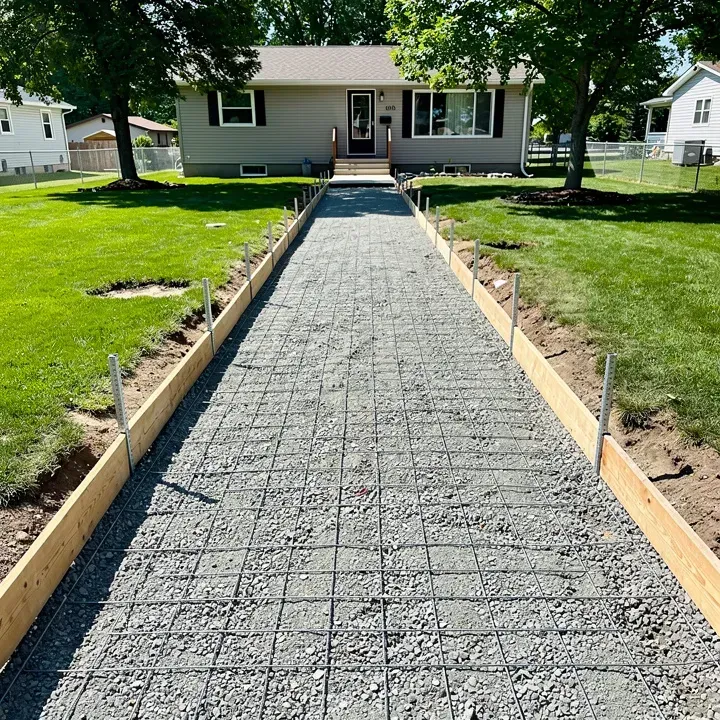
We begin every sidewalk project by removing the existing walkway if one is present, then excavating to establish a proper, even grade along the entire length of the new sidewalk. Getting this grading right is one of the most important parts of the process, since a sidewalk that isn't graded correctly will develop low spots where water pools and refreezes, creating exactly the kind of hazard we're trying to eliminate.
Once the site is graded, we install a compacted base layer to give the concrete stable, long-term support and help prevent future settling, particularly important in areas where the sidewalk crosses softer soil or runs near trees with active root systems. Forms are then set to establish the width and path of the walkway, and we place control joints at regular intervals to control where the concrete will crack as it naturally expands and contracts with temperature changes, keeping any future cracking predictable and minimal rather than random and unsightly.
The concrete is poured, leveled, and finished with a broom texture that provides reliable traction underfoot in all weather conditions, including when wet or lightly icy. We pay close attention to consistent slope across the entire walkway so water always drains away rather than collecting in any one spot.
What Affects the Cost of a Concrete Sidewalk?
The total length and width of the sidewalk are the primary factors driving cost, since more concrete and more labor are required for longer or wider walkways. The condition of the site also plays a role. A straightforward, level path costs less to install than one that requires significant grading, has tree roots that need to be addressed, or involves working around existing landscaping, retaining walls, or utility lines.
Removal of an existing sidewalk, if one is already in place, adds to the cost due to the labor and disposal involved, particularly with older concrete that may be thicker or reinforced differently than current standards. Finish options also factor into the price, though most sidewalks use a standard broom finish given its practicality and durability for daily foot traffic. We provide a clear, itemized estimate for every sidewalk project so you understand exactly what you're paying for and why.
Frequently Asked Questions
Can tree roots damage a new sidewalk after it's installed?
They can, particularly if a sidewalk runs close to a mature tree with an aggressive root system, which is fairly common on older properties throughout the Baxter area. Roots seeking moisture and nutrients will grow toward and underneath concrete over time, and as they thicken, they can gradually lift sections of the sidewalk, creating exactly the kind of uneven surface and tripping hazard we're trying to prevent in the first place.
During our site assessment, we take a close look at any nearby trees and their likely root patterns before finalizing the design. Depending on the situation, we may recommend installing a root barrier between the tree and the new sidewalk to redirect root growth away from the concrete, adjusting the path of the sidewalk slightly to gain more distance from the tree, or in some cases recommending a different paving approach altogether if the root system is extensive enough that long-term heaving is difficult to avoid. We'd rather flag this concern up front than have you deal with a lifted sidewalk again in a few years.
How long does it take to install a new sidewalk?
Most residential sidewalk projects are completed within one to two days of active on-site work, though the exact timeline depends on the length of the walkway, the amount of site preparation required, and whether an existing sidewalk needs to be removed first. A short, straightforward walkway with good existing grading might only take a single day from form-setting to the final pour. A longer sidewalk, one that requires significant grading corrections, or a project that involves removing old concrete and addressing root damage underneath will naturally take longer.
Beyond the on-site work itself, you'll also want to factor in curing time before the sidewalk sees regular foot traffic. We typically recommend staying off a newly poured sidewalk for at least 24 to 48 hours, and we'll give you a specific, realistic timeline for your project during the estimate so you know exactly what to expect from start to finish.
How wide should a residential sidewalk be?
Most residential sidewalks are built at a width of three to four feet, which comfortably accommodates one person walking and allows for occasional two-person passing without anyone needing to step onto the grass. The right width for your project depends on how the walkway will actually be used. A simple path from the driveway to the front door might work fine at three feet, while a sidewalk that sees heavier daily traffic, connects multiple areas of the property, or needs to accommodate things like a stroller or wheelchair access may benefit from the extra space that four feet provides. We walk through these considerations with you during the estimate so the finished width fits how your household actually uses the space, not just a generic standard.
Is a permit required to replace a sidewalk in Baxter?
In many cases, replacing an existing residential sidewalk on your own property does not require a permit, particularly when the work doesn't change the sidewalk's footprint, grading, or proximity to public right-of-way areas. However, requirements can vary depending on the specific location of the sidewalk and whether it's near a street, easement, or shared property line. We're familiar with local requirements in the Baxter area and will let you know during your estimate whether your specific project is likely to need a permit, so there are no surprises once work begins.
Ready to Get Started? Let's Talk About Your Project.
Don't let a concrete problem sit another season. Every Minnesota winter that passes makes a cracked driveway, a sunken slab, or a deteriorating surface worse than it was the year before. Whether you're dealing with damage that's been building up for years or you're ready to add a patio, sidewalk, or foundation to your property, Baxter Concrete Solutions is ready to help. Call us today for a free estimate and get a straight answer from a local contractor who knows what he's doing and stands behind every project he completes.

Contact
(218) 394-4653
Mon–Sun: 7am–7pm
Baxter, MN
About Us
Baxter Concrete Solutions is a locally owned concrete contractor serving residential homeowners in Baxter and the broader Brainerd Lakes area. We handle all types of residential concrete work and take pride in doing it right the first time. Fully licensed and insured in Minnesota, we proudly serve homeowners throughout Crow Wing County and surrounding communities including Brainerd, Nisswa, Pequot Lakes, Crosslake, Crosby, Deerwood, and Garrison. We'd love to help with your next project.
© Copyright 2026 Baxter Concrete Solutions. All rights reserved.
© Copyright 2026 Baxter Concrete Solutions.
All rights reserved.