
Concrete Block Wall Installation in Baxter, MN
Baxter Concrete Solutions builds concrete block walls for homeowners throughout Baxter and the surrounding Brainerd Lakes area, including retaining walls, garden borders, and structural barriers built to last.
20+
Years in Business
425+
Projects Completed
4.9 ★
Average Review Rating
A Block Wall That Holds Up to Minnesota Terrain
A concrete block wall provides a strong, long-lasting solution for managing sloped or uneven terrain, defining garden and landscape boundaries, or creating a structural barrier where one is needed on your property. Homeowners typically turn to a block wall when they're dealing with a slope that's eroding or difficult to maintain, want to create level, usable areas in an otherwise sloped yard, or need a sturdy border between different sections of their landscaping. A well-built block wall solves these problems while adding a clean, finished look to the property, and when constructed correctly, it holds up reliably against the freeze-thaw pressures and soil movement common throughout central Minnesota.
Why Concrete Block Is a Smart Choice in South Louisiana
CMU construction handles the local climate better than most alternatives. Concrete block does not rot, warp, or deteriorate from moisture exposure the way wood does. It resists termites, which are a serious and persistent problem throughout the greater New Orleans area. It holds up to wind, heat, and humidity without the ongoing maintenance that other materials demand.
For homeowners who want a permanent, low-maintenance wall that genuinely lasts in this climate, concrete block is consistently the most practical and cost-effective choice.
When Does Your Property Need a Block Wall?
Homeowners typically consider a concrete block wall when they're dealing with a sloped yard that's prone to erosion, especially after heavy rain, when soil and mulch wash downhill and create an ongoing maintenance headache. A retaining wall stops that erosion in its tracks and creates a stable, level area that can be used for landscaping, a garden bed, or simply a cleaner looking yard. Others need a block wall to create separation between different elevations on a property, such as a raised patio area or a driveway that sits at a different grade than the surrounding yard.
Ignoring a slope that's actively eroding or shifting tends to make the underlying problem worse over time. Soil that continues to wash away can eventually undermine nearby structures, walkways, or even a home's foundation if the slope is close enough. What might be addressed today with a moderately sized retaining wall can turn into a significantly larger and more expensive project if the erosion is allowed to continue unchecked for several more years.
How We Build a Concrete Block WallBlock Wall Is Built
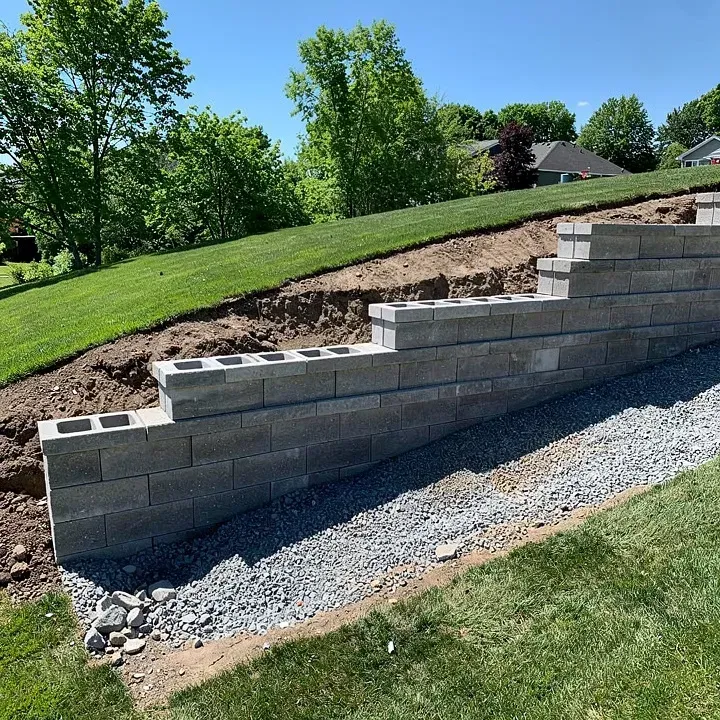
Every block wall project starts with an assessment of the slope, soil conditions, and the height the wall needs to reach, since these factors determine the structural requirements of the wall. We excavate a trench for the wall's footing and install a compacted base of gravel to provide proper drainage and a stable foundation for the first course of blocks, which is the most important step in ensuring the wall stays level and doesn't shift over time.
Blocks are then set course by course, with attention paid to proper alignment, level, and the slight backward lean, known as batter, that gives retaining walls additional stability against the soil pressure behind them. For taller walls or walls holding back significant soil pressure, we install geogrid reinforcement that extends back into the soil behind the wall, anchoring it more securely than the blocks alone could provide.
Proper drainage is essential to a wall's long-term performance, so we install drainage gravel and, when necessary, a perforated drain pipe behind the wall to relieve water pressure that would otherwise build up and push against the structure, particularly during Minnesota's spring thaw when significant water can be moving through the soil. The final course is capped with finishing blocks for a clean, completed appearance, and any backfill is properly compacted to support the soil behind the wall.
What Affects the Cost of a Concrete Block Wall?
The height and length of the wall are the primary cost drivers, since taller walls require additional structural reinforcement such as geogrid and a more substantial base, while longer walls naturally require more material and labor. The amount of soil pressure the wall needs to hold back, influenced by the slope's steepness and the soil type on your property, also affects the engineering and reinforcement requirements, which in turn affects cost.
Site accessibility plays a role as well, since walls in difficult to access areas of a property may require more manual labor to transport blocks and materials compared to a wall built in an easily accessible spot. Drainage requirements, including the installation of drain pipe and gravel backfill, add to the project scope and cost but are essential for the long-term performance of the wall. We evaluate all of these factors during your free estimate and provide a clear breakdown of what your specific project requires.
Frequently Asked Questions
Why does drainage matter so much for a retaining wall?
Water buildup behind a retaining wall creates significant pressure that, over time, can cause the wall to shift, lean, or fail entirely if it isn't properly managed. We install drainage gravel and, when needed, a drain pipe behind every wall we build to relieve that pressure and keep the wall stable for the long term, especially important given how much water moves through the soil during Minnesota's spring thaw.
Do I need a permit to build a retaining wall?
It depends on the height of the wall and local requirements. Many shorter walls do not require a permit, while taller walls or those near property lines may need one. We're familiar with the requirements in the Baxter area and will let you know during your estimate whether your specific project needs a permit.
How tall can a concrete block retaining wall be?
Retaining walls can be built to a wide range of heights, but taller walls require additional engineering considerations such as geogrid reinforcement and, in some cases, a building permit. We assess the height needed for your specific slope during the estimate and let you know what additional requirements, if any, apply to your project.
Ready to Get Started? Let's Talk About Your Project.
Don't let a concrete problem sit another season. Every Minnesota winter that passes makes a cracked driveway, a sunken slab, or a deteriorating surface worse than it was the year before. Whether you're dealing with damage that's been building up for years or you're ready to add a patio, sidewalk, or foundation to your property, Baxter Concrete Solutions is ready to help. Call us today for a free estimate and get a straight answer from a local contractor who knows what he's doing and stands behind every project he completes.

Contact
(218) 394-4653
Mon–Sun: 7am–7pm
Baxter, MN
About Us
Baxter Concrete Solutions is a locally owned concrete contractor serving residential homeowners in Baxter and the broader Brainerd Lakes area. We handle all types of residential concrete work and take pride in doing it right the first time. Fully licensed and insured in Minnesota, we proudly serve homeowners throughout Crow Wing County and surrounding communities including Brainerd, Nisswa, Pequot Lakes, Crosslake, Crosby, Deerwood, and Garrison. We'd love to help with your next project.
© Copyright 2026 Baxter Concrete Solutions. All rights reserved.
© Copyright 2026 Baxter Concrete Solutions.
All rights reserved.